This is an authorized blue-team defense-validation exercise: prove a known
PHP remote-code-execution (RCE) is exploitable, contain it at runtime with
AppArmor, re-test to confirm the exploit is neutralized, and finally fix the
root cause in source code. Everything below uses documentation ranges
(10.0.0.0/8, example.com) — sample artifacts only.
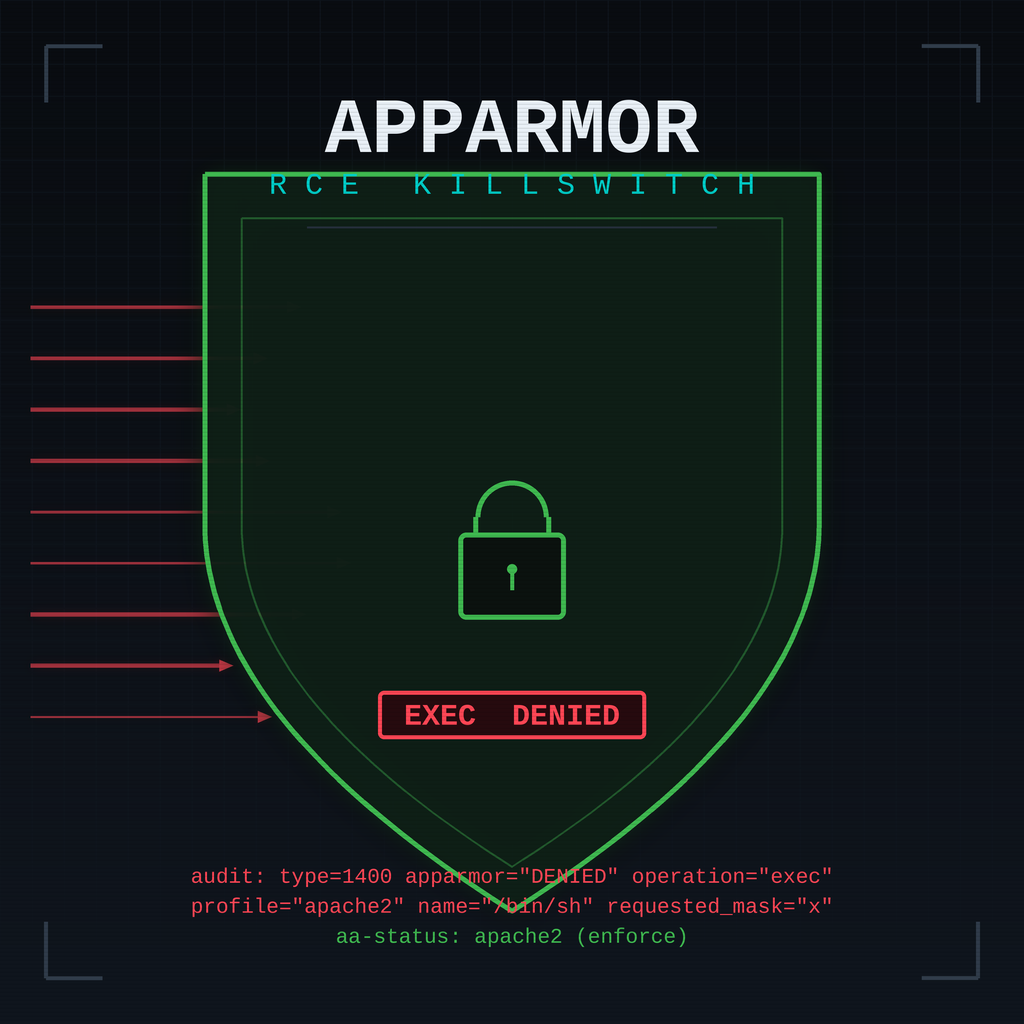
⚠️ Technical note: AppArmor is a path- and capability-based LSM. It confines a process by denying execution of specific binaries, file writes, and network access — it is not a syscall filter (that is seccomp’s job). What it does is stop the web process from ever
execve()-ing/bin/sh, which is exactly what an RCE payload needs. The result is the same from the attacker’s perspective: the RCE is dead.
1. The Target: A Vulnerable Endpoint
A basic PHP demo endpoint passes unsanitized user input straight to a shell:
<?php
  // vuln.php — intentionally vulnerable, demo only
  $cmd = $_GET['cmd'];
  system($cmd);
?>
Root cause: user-controlled input is concatenated into a shell command via
system(). No validation, no escaping, no allowlist.
2. Exploitation (Proof of Concept)
$ curl "http://10.0.0.5/vuln.php?cmd=id"
uid=33(www-data) gid=33(www-data) groups=33(www-data)

$ curl "http://10.0.0.5/vuln.php?cmd=cat+/etc/passwd"
root❌0:0:root:/root:/bin/bash
daemon❌1:1:daemon:/usr/sbin/nologin
...

$ curl "http://10.0.0.5/vuln.php?cmd=rm+-rf+/var/www/html/evil.php"
# arbitrary command execution as the web user — RCE confirmedThe exploit works. We now have command execution in the context of the
www-data user that runs Apache + mod_php.
3. Mitigation A — AppArmor Confinement (Compensating Control)
AppArmor confines the interpreter process (Apache/mod_php), not the PHP code.
We attach a profile that denies the web process from spawning interpreters/shells,
opening network connections, or writing outside its docroot.
/etc/apparmor.d/usr.sbin.apache2 (added rules):
profile apache2 /usr/sbin/apache2 flags=(attach_disconnected) {
  #include <abstractions/apache2>
  #include <abstractions/base>

  # Deny executing interpreters / shells -> kills RCE payload exec
  deny /bin/** x,
  deny /usr/bin/** x,
  deny /usr/sbin/** x,
  deny /bin/sh ix,
  deny /bin/bash ix,
  deny /usr/bin/python* ix,

  # Deny raw network egress from the web process
  deny network inet,
  deny network inet6,

  # Deny writes outside the docroot
  deny /var/www/** w,
  audit /var/www/html/** w,

  # Drop capabilities the web server never needs
  deny capability sys_admin,
  deny capability dac_override,
}
Enforce it:
$ sudo aa-enforce apache2
$ sudo systemctl reload apparmor

$ aa-status | grep apache2
apache2 (enforce)Tip: profile in complain mode first (
aa-complain apache2), watch/var/log/audit/audit.log, then flip to enforce once legitimate traffic is clean. An over-tight profile will also block image-processing binaries, so validate before enforcing.
4. Re-Test — Exploit Blocked
$ curl "http://10.0.0.5/vuln.php?cmd=id"
<br />
<b>Warning</b>: system(): Unable to execute command via shell: Permission denied ...The kernel’s LSM denies the execve(), so the payload never runs:
$ sudo dmesg | tail -n 3
[ 1284.62] audit: type=1400 apparmor="DENIED" operation="exec"
           profile="apache2" name="/bin/sh" pid=2148
requested_mask="x" denied_mask="x" fsuid=33 ouid=0The RCE is neutralized at the process boundary — even though the vulnerable PHP code is still present. That is the whole point of a compensating control: buy time and limit blast radius before the source fix lands.
5. Mitigation B — Source Code Remediation (The Real Fix)
AppArmor is defense-in-depth, not the root fix. The proper remediation removes the dangerous primitive entirely.
Bad:
system($_GET['cmd']); // never do this
Good — validate against an allowlist, avoid the shell:
<?php
  // safe.php
  $allowed = ['status', 'version'];
  $cmd = $_GET['cmd'] ?? '';
  if (!in_array($cmd, $allowed, true)) {
      http_response_code(400);
      exit('invalid command');
  }
  echo match ($cmd) {
      'status'  => shell_exec('systemctl is-active apache2'),
      'version' => phpversion(),
  };
?>
And disable dangerous functions globally in php.ini:
disable_functions = exec,passthru,shell_exec,system,proc_open,popen,pcntl_execRe-test after the fix — and after removing the AppArmor profile — the endpoint
returns 400 for anything outside the allowlist.
6. Validation Workflow Summary
| Step | Action | Result |
|---|---|---|
| 1 | Exploit vuln.php?cmd=id | ✅ RCE as www-data |
| 2 | Attach AppArmor profile, aa-enforce | Profile enforce |
| 3 | Re-exploit | ❌ apparmor="DENIED" exec /bin/sh |
| 4 | Remediate source + disable_functions | Root cause closed |
| 5 | Remove compensating profile, re-test | Still safe (allowlist) |
7. Lessons Learned
- AppArmor = runtime containment — an RCE killswitch while you ship the real fix.
- Source fix = root cause — never rely on the LSM as the only defense.
- Least privilege — the web process should not be able to exec shells or open arbitrary sockets.
- seccomp is complementary — if you need syscall-level restriction (e.g. block
execvesystem-wide for a service), layer seccomp/BPF-LSM on top. - Complain → Enforce — profile safely before enforcing in production.
Defense in depth: confine the process, fix the code, disable the footguns. 🛡️