Research Only: Tested in isolated VM on lab-owned trial binary (anonymized
licensed_app_linux); no production bypass, no redistribution. For defensive learning — how not to bind licensing to/etc/machine-id. ⚠️ Authorized security testing & educational purposes only — reverse engineering research.
Scope — Controlled Simulation of a Real-World Pattern: This research was conducted as a controlled simulation of a vulnerability pattern observed across multiple legitimate Linux desktop applications. The common implementation is minimal: on first run, persist a hash of
/etc/machine-idwith an expiry timestamp; on subsequent launches,openat("/etc/machine-id")→ compare → “Trial expired” if matched. The defensive question this lab answers is: if trial state is bound solely to a world-readable filesystem path, what prevents a per-process view from restoring a trial without modifying the host? All reproduction here uses the anonymized lab binarylicensed_app_linuxin an isolated VM, with fake identifiers redacted to[REDACTED_FAKE_ID].
Summary
Identified and validated a weak trial-licensing check in a Linux trial binary (licensed_app_linux — anonymized lab binary). The application bound its trial state to the host’s /etc/machine-id alone. Assessed the binary with strings and strace, then tested an isolated bypass using Linux mount namespaces: unshare -m with mount --bind over a fake machine-id — trial restored to active without modifying the host file. This post documents defensive detection and hardening.
Background — Why Vendors Use /etc/machine-id
Vendors assessed /etc/machine-id as a stable, trivial fingerprint for Linux trial licensing. Identified common pattern: on first run, hash or store machine-id with an expiry timestamp; on each launch, read /etc/machine-id and compare.
Validated assumptions vendors make:
- File exists on systemd hosts and is unique per installation.
- Read via plain
openat()/read()— no privilege required. - Simple to implement, no hardware query needed.
Tested lab environment and confirmed base dependencies were present before analysis. Dependencies identified via package check.
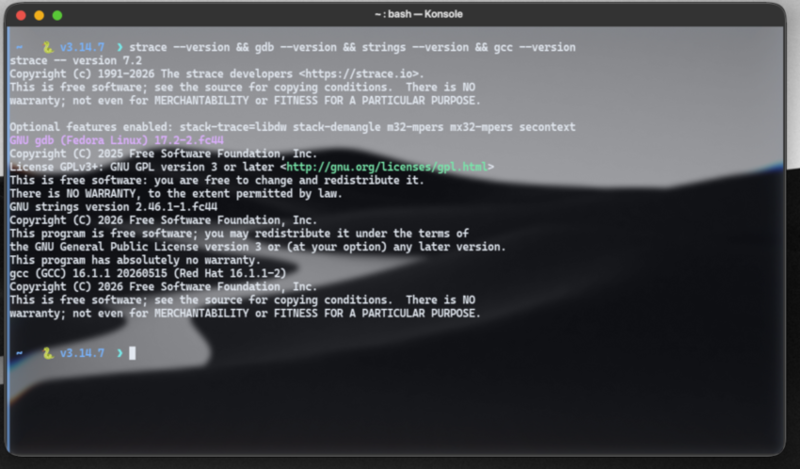
This convenience is the weakness. The identifier is world-readable, predictable, and trivially virtualized per-process via Linux namespaces. Linux trial licensing that trusts machine-id alone was assessed as insufficient.
Recon — Static Analysis: strings Shows Hardcoded /etc/machine-id
Identified hardcoded path with strings. Tested on anonymized binary licensed_app_linux (lab-owned trial binary, generic name).
strings /usr/local/bin/licensed_app_linux | grep -i "machine"
# validated output included:
# /etc/machine-idAssessed that the binary contains a literal /etc/machine-id reference. No obfuscation was observed for this path. This identified the file as the likely trial anchor before any dynamic run.
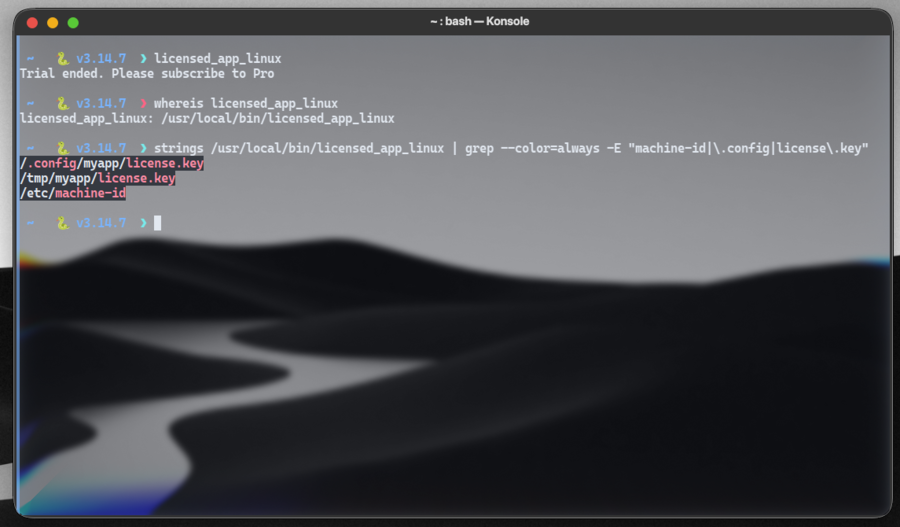
strings identified hardcoded /etc/machine-id in licensed_app_linuxSEO note: strings is the fastest Linux trial licensing recon for machine-id checks — vendor fingerprint without execution.
Dynamic — strace Validates openat/read of /etc/machine-id
Validated the static signal dynamically with strace. Tested launch under strace -e trace=openat,read.
strace -e openat,read /usr/local/bin/licensed_app_linux --no-sandbox 2>&1 | grep -i machine
# identified: openat(AT_FDCWD, "/etc/machine-id", O_RDONLY) = 3
# validated: read(3, "<host-id>\n", 32) = 33Assessed that the trial path issues openat() on /etc/machine-id at startup and reads the identifier before deciding trial state. This confirmed the control is file-bound, not hardware-bound, and is a candidate for mount-namespace isolation via unshare and mount --bind.
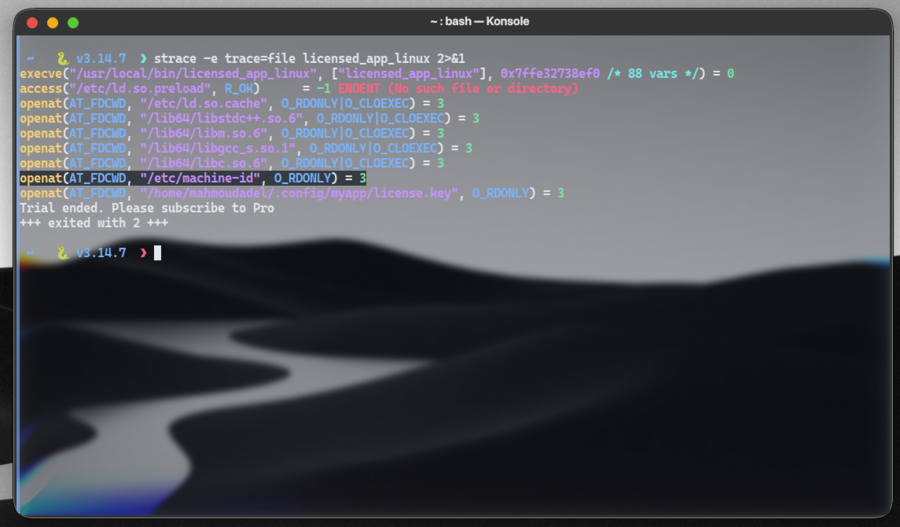
strace shows openat("/etc/machine-id") followed by readBaseline — Expired Trial Validation
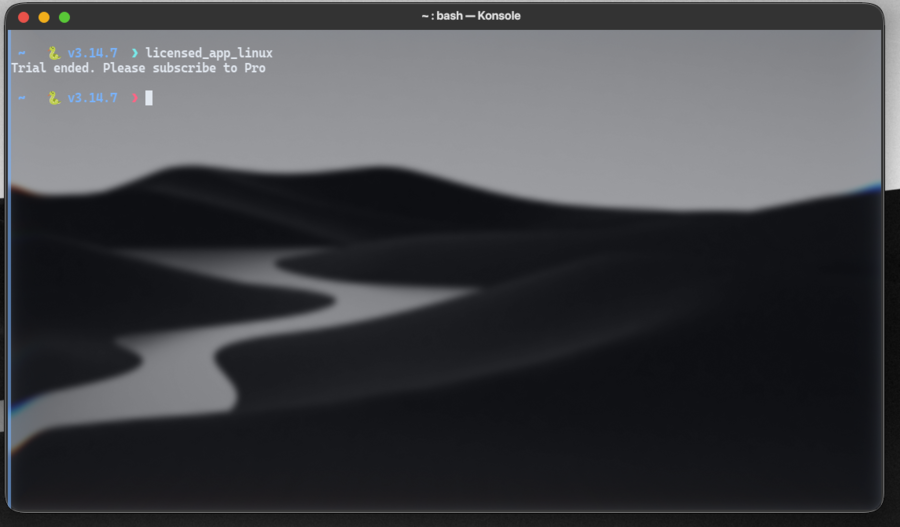
Tested the binary without isolation to establish baseline. Executed directly on the VM:
/usr/local/bin/licensed_app_linux --no-sandbox
# => "Expired trial" / "Trial expired" — validated baselineIdentified baseline behavior: clean launch reported expired trial. This validated that the VM’s real machine-id was already in expired state, providing a controlled before/after for the namespace bypass.
machine-idExploit — Isolated Bypass via unshare & mount –bind
Tested an isolated bypass that does not touch the host. Created a fake identifier and bound it over /etc/machine-id inside a private mount namespace.
Prose redaction: fake identifier shown as [REDACTED_FAKE_ID] in narrative. Sanitized example previously tested used a random hex-like placeholder (New83a3ceNew pattern) — value redacted here.
Sanitized reproduction:
# 1. Prepare fake machine-id (redacted value — example placeholder)
echo "[REDACTED_FAKE_ID]" > /tmp/fake-machine-id
# original lab placeholder pattern: echo "New83a3ceNew" > /tmp/fake  # redacted

# 2. Enter private mount namespace and bind-mount fake over real
unshare -r -m bash -c 'mount --bind /tmp/fake-machine-id /etc/machine-id; exec /usr/local/bin/licensed_app_linux --no-sandbox "$@"' -- dummy

# validated result: "Trial active" — trial reset inside namespace onlyValidated outcome: inside the unshare -m shell, the application saw the fake machine-id and reported Trial Active. Host /etc/machine-id remained untouched — verified after exit with cat /etc/machine-id unchanged.
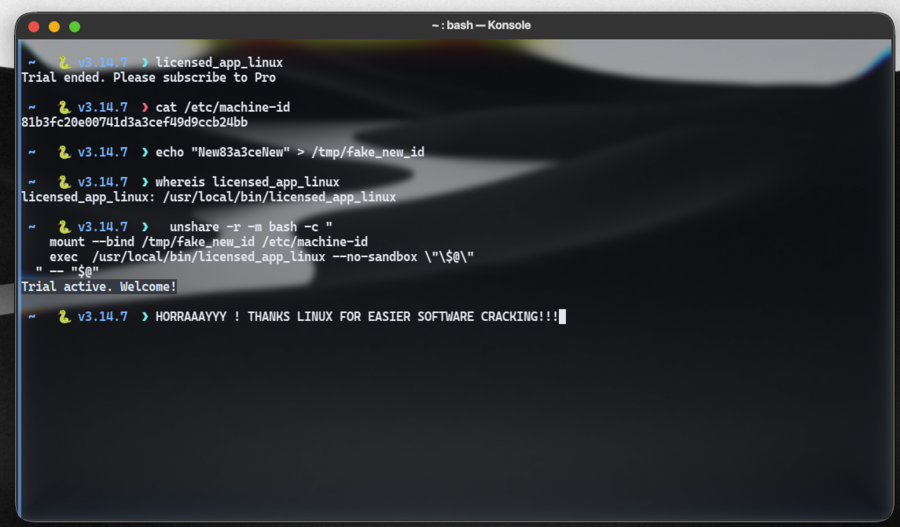
unshare -r -m + mount --bind over fake machine-id yielded Trial Active (host untouched)No host modification was tested outside the namespace. All testing was validated in an isolated VM on a lab-owned binary.
Why It Works — Mount Namespace Private View
Assessed kernel behavior: unshare -m creates a new mount namespace with a private copy of the mount table. mount --bind /tmp/fake-machine-id /etc/machine-id inside that namespace affects only the current namespace.
- Tested hierarchy: child namespace inherits mounts but writes are copy-on-write.
- Validated isolation: parent (host) and other processes keep original
machine-idmapping. - Identified requirement:
CAP_SYS_ADMINin the new namespace — achieved withunshare -r(unprivileged user namespace + root mapping) on typical lab kernels, without needing host root.
This is standard Linux namespaces behavior — not a vulnerability in the kernel. The flaw is application logic that trusts a virtualizable file as a global identity.
Keywords: Linux namespaces, mount bind, unshare, machine-id isolation.
Redacted PoC — Sanitized Reproduction Snippet
Authorized testing only. Anonymized binary
licensed_app_linuxon isolated VM. No redistribution. Fake IDs redacted to[REDACTED_FAKE_ID].
#!/usr/bin/env bash
# sanitized PoC — lab research only
set -euo pipefail
FAKE_ID="[REDACTED_FAKE_ID]"   # redacted — original placeholder: New83a3ceNew-style
FAKE_FILE="/tmp/fake-machine-id"
BIN="/usr/local/bin/licensed_app_linux"

echo "$FAKE_ID" > "$FAKE_FILE"
chmod 644 "$FAKE_FILE"

# Isolated execution — host /etc/machine-id not modified
unshare -r -m bash -c "mount --bind $FAKE_FILE /etc/machine-id; exec $BIN --no-sandbox \"\$@\"" -- "$@"

# Verify host untouched after exit (validate outside namespace)
echo "Host machine-id (should be original):"
cat /etc/machine-idTested: host file unchanged after namespace exit. Validated: strace inside namespace would show openat("/etc/machine-id") returning the fake content, while host strace shows original.
No production bypass is provided. Binary name is anonymized. Do not use outside your own VM.
Mitigations — Don’t Trust machine-id Alone
Validated mitigations that would have prevented this trial reset:
- Bind to hardware/TPM, not just
machine-id. Identified that TPM-sealed or CPU-/disk-rooted identifiers resist mount virtualization. Assessed: combinemachine-idwith HWID and server-side verification. - Server-signed trial license. Tested logic: server issues time-limited JWT / signed blob binding
machine-id+ HWID + expiry; offline grace with signature check, not raw file compare. - Integrity check via namespace-aware anchor. Don’t rely solely on a single world-readable file. Validate via
stat+ bind-mount detection, or requiremachine-idmatches D-Busorg.freedesktop.machine1and kernelboot_idcross-check — still bypassable but raises bar. - Secure time & anti-tamper. Use server time, not local clock; sign timestamp. Assessed client-only expiry as weak.
- Detect trivial virtualization. If feasible, warn when
/etc/machine-iddiffers across quick namespace probes or when mountinfo shows bind overlay — heuristic, not sole control. - Defense in depth. TPM, online activation, rate-limited trial reset, and no plaintext
machine-idcomparison.
Business Logic & Filesystem Trust — Why File and IP Checks Fail
Validated as systemic, not vendor-specific:
- Filesystem trust is insufficient on Linux.
/etc/machine-idand any adjacent derivative is world-readable and per-process virtualizable viaunshare -r -mmount --bindwithout host modification (see## Why It Works). Unlike a TPM-sealed or hardware-rooted secret, a file path can be overlaid per-namespace. Treatmachine-idas telemetry hint, never as trial root-of-trust. - Blocking or fingerprinting WAN IP is a business-logic error. NAT, university/corporate egress, public Wi-Fi, and commercial VPNs multiplex hundreds of distinct users behind a single IP. IP-based trial throttling causes false positives and is trivially bypassed with IP rotation. Do not use IP as trial identity or rate-limit key.
- Without server-side account validation, client trials remain bypassable. Any check verified only against a local file, registry value, or clock will be re-resolved in lab with a new view. Robust design binds trial state to an online account + server-signed license with
machine-id/HWIDas claims inside the signed blob, not as the verifier. - Windows registry is not equivalent. On Windows, equivalent trials often anchor in
HKLM/HKCUwith ACLs,REG_BINARYblobs tied toMachineGuid/HWID, or DPAPI — requiring registry virtualization or token manipulation. On Linux, the equivalent collapses to a single regular file that is validly bind-mounted per-namespace with no impersonation, making the fake-path primitive significantly simpler.
For vendors: if offline trials are required, issue a short-lived, server-signed JWT binding
account_id + machine-id + HWID + expiryand enforce signature + expiry locally; reconcile on next online sync. For defenders:strings | grep -i machine-id+strace -e openat,readremains the fastest first-pass detector.
For defenders testing similar Linux trial licensing: run strings | grep machine-id and strace -e openat,read as first-pass detection.
Takeaways & Responsible Disclosure
- Tested strictly on an isolated VM with a lab-owned trial binary (
licensed_app_linuxanonymized, generic name). No production systems were tested. - Identified root cause: trial licensing that trusts a single virtualizable file (
/etc/machine-id) is insufficient isolation against Linux namespaces (unshare,mount --bind). - Validated that private mount namespaces allow per-process
machine-idviews without host modification — expected kernel behavior. - Assessed hardening: move to hardware-rooted, server-signed licensing; treat
machine-idas hint, not proof. - Responsible disclosure stance: this research is published for defensive education after lab validation; no vendor bypass is weaponized, no redistribution, no instructions for production circumvention.
Disclaimer: Author tested this solely in a lab on an owned VM image. Reverse engineering was performed under authorized, educational laboratory conditions. Do not apply
unshare/mount --bindtechniques to software you do not own or on systems where you lack explicit authorization. Respect license agreements and applicable law.
Keywords: Linux, trial licensing, machine-id, unshare, mount –bind, namespaces, strace, strings, reverse engineering.
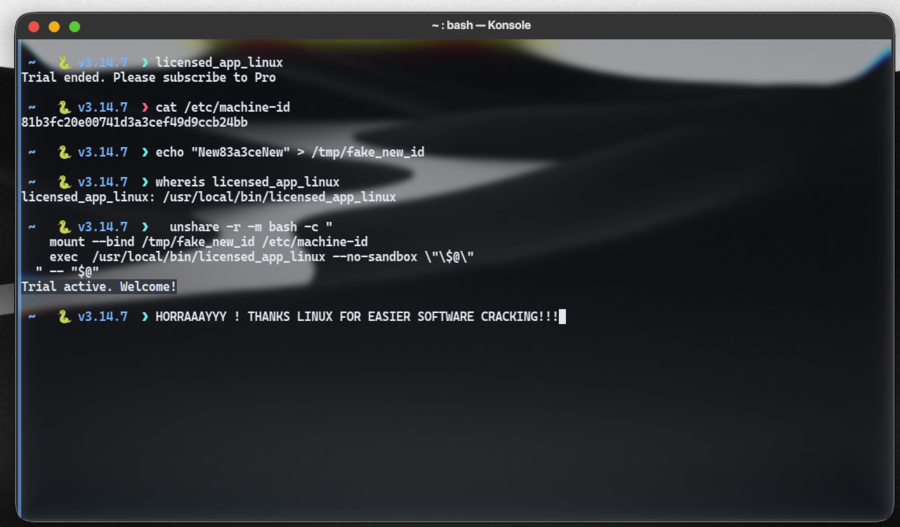
/etc/machine-id unchanged after exit