Note: Sensitive values (authorization codes, cookies, session IDs) have been redacted to
[REDACTED]. Host and flow are preserved for reproducibility.
Summary
Identified and validated a Cross-Site Request Forgery (CSRF) vulnerability in the Google OAuth account linking flow of Verisign DomainScope (domainscope.com). The OAuth callback at /connect/google did not validate the state parameter. An attacker could force a victim’s authenticated session to link the attacker’s Google account to the victim’s DomainScope profile, then authenticate as the victim via Google OAuth. Impact was full account takeover without needing the victim’s password. Reported via Bugcrowd in April 2018 within the authorized Verisign bug bounty program, triaged and rewarded $1,000, and acknowledged in the Verisign Hall of Fame. Found during Bugcrowd program participation as part of authorized penetration testing.
Background — OAuth Linking Flow in DomainScope
Verisign DomainScope supported two related authentication flows at the time of testing:
- Primary sign-in: Users could sign in to DomainScope with LinkedIn OAuth.
- Account linking in My Profile: An authenticated user could visit My Profile → Link Google Account to associate a Google identity with their existing DomainScope profile. After linking, the user could subsequently authenticate to DomainScope via Sign in with Google.
The intended OAuth 2.0 flow for linking was:
- User clicks Link Google Account while authenticated to DomainScope.
- Browser redirects to
https://accounts.google.comfor Google authorization. - Google redirects back to DomainScope’s callback
GET /connect/google?code=...&state=...with an authorization code and astatevalue that should be bound to the user’s session. - DomainScope exchanges the code for tokens and links the returned Google identity (
email,profile) to the currently authenticated DomainScope account.
The state parameter is defined in RFC 6749 as the CSRF protection for OAuth. When linking an external identity to an already-authenticated account, state is critical. Without it, the link action is not bound to the user who initiated it.
Vulnerability — Missing State Parameter Verification Enables CSRF
Assessed the /connect/google callback and documented that the state parameter was not validated. The application accepted a callback containing only code and scope, without requiring a cryptographically random state tied to the victim’s session.
Validated behavior:
- Interception of the Google OAuth callback showed the request could be replayed without a
statevalue. - Removing the
stateparameter still resulted in a successful link between the DomainScope session and the Google identity represented by thecode. - No anti-CSRF token,
SameSiteenforcement, or server-side session binding was observed on this linking endpoint at the time of testing.
In OAuth account linking, the missing state check turns the callback into a CSRF endpoint. An attacker can prepare a valid authorization code for their own Google account and make a victim’s browser deliver it to the victim’s DomainScope session. The victim’s account becomes linked to the attacker’s Google identity.
This class of OAuth CSRF is often missed during testing because reviewers focus on login flows and overlook linking and unlinking flows in profile settings.
Steps to Reproduce (Sanitized)
All testing was performed using only accounts owned and controlled for the purpose of the assessment. No victim data was accessed.
Prerequisites: Two test accounts — a victim account (victim@...) authenticated to DomainScope, and an attacker-controlled Google account. Tools: browser with intercepting proxy.
Step 1 — Initiate attacker Google authorization:
- Sign in to DomainScope with LinkedIn (or primary identity) using the attacker-controlled test session.
- Navigate to My Profile → Link Google Account.
- Complete Google authorization with the attacker-controlled Google account.
- Intercept the callback to DomainScope:
GET /connect/google?code=[REDACTED_AUTHORIZATION_CODE]&scope=email+profile&state=[REDACTED] HTTP/1.1 - Document the callback URL and drop or hold the request. Extract the
codevalue. Note that the application did not enforcestate— removing it still succeeded when replayed.
Step 2 — Create CSRF proof-of-concept for the victim:
- Craft a minimal HTML page that triggers a GET to the callback with the attacker’s code and without a valid
state:<!-- csrf-poc.html — redacted, for authorized reproduction only --> <html> <body> <img src="https://domainscope.com/connect/google?code=[REDACTED_AUTHORIZATION_CODE]&scope=email+profile" style="display:none"> <!-- Alternative: auto-submit form or window.location --> <script>window.location = "https://domainscope.com/connect/google?code=[REDACTED_AUTHORIZATION_CODE]&scope=email+profile";</script> </body> </html> - Host this page on an attacker-controlled origin (in testing, a local file).
Step 3 — Victim interaction and takeover:
- While the victim is authenticated to DomainScope (active session via
JSESSIONID/ session cookies), have the victim visit the PoC URL. In real attack scenarios this is via phishing link or embedded resource. - The victim’s browser sends the authenticated request to
/connect/googlewith the attacker’s code. DomainScope links the attacker’s Google identity to the victim’s profile. - Attacker then visits DomainScope and selects Sign in with Google, authenticating with the attacker-controlled Google account. The attacker is now authenticated as the victim — full account takeover with no password required. From there, the attacker can set a new password via My Profile without needing the current password (business logic for LinkedIn-first accounts), achieving persistent takeover.
The vulnerability was validated using two accounts owned by the researcher. No other accounts were tested or accessed.
Redacted PoC Request
Note: Sensitive values (authorization codes, cookies, session IDs) have been redacted to
[REDACTED]. Host and flow are preserved for reproducibility. A PoC video was recorded for the Bugcrowd report; no live exploit is published.
Original callback intercepted via proxy (sanitized):
GET /connect/google?code=[REDACTED_AUTHORIZATION_CODE]&scope=email+profile HTTP/1.1
Host: domainscope.com
User-Agent: Mozilla/5.0 [REDACTED]
Accept: text/html,application/xhtml+xml,application/xml;q=0.9,*/*;q=0.8
Accept-Language: en-US,en;q=0.5
Referer: https://accounts.google.com/... [REDACTED]
Cookie: [REDACTED_SESSION_COOKIES]
Connection: close
Redacted details:
code=4%2F...(long authorization code) →code=[REDACTED_AUTHORIZATION_CODE]Cookie: s_fid=... s_evar... JSESSIONID=...(full session) →Cookie: [REDACTED_SESSION_COOKIES]andJSESSIONID=[REDACTED]Referer: https://accounts.google.com/o/oauth2/...?client_id=...&xsrfsig=...→Referer: https://accounts.google.com/... [REDACTED]client_idvalue →[REDACTED_CLIENT_ID]xsrfsigand other long tokens →[REDACTED]scope=email profile ...generalized toemail+profileHost: domainscope.compreserved — it identifies Verisign’s DomainScope, which is public.
Scope was observed as email profile (generalized). No additional PII or token chains are included.
Impact — Full Account Takeover via Google OAuth Linking
Validated impact was full account takeover at the application layer:
- Authentication bypass: After successful CSRF linking, the attacker authenticates through the trusted Google OAuth flow. The application treats the Google identity as the account owner.
- No password needed: The victim’s password, if any, is not required. The linked Google account becomes an alternate authentication path.
- Scope: Any DomainScope account with an active session that visited the crafted link could be linked to the attacker’s Google identity. The linking action is state-changing and was not protected by a CSRF token.
- Persistence: Once linked, the attacker retains access via Google sign-in until the link is manually removed by the victim or by support. The victim may not notice the additional linked identity in profile settings.
Why password change was not required — business logic: DomainScope’s primary login at the time was LinkedIn OAuth. After linking, the account’s password-change function in My Profile did not require the current password — a deliberate business logic decision for OAuth-first accounts that had no password set. Once an attacker was authenticated via the hijacked Google link (as the victim), they could go to My Profile → Change Password, set a new password without supplying the current one, and thereafter retain access via both Google OAuth and the newly set password — even if the victim later unlinked the Google account.
The finding was reported as a validated CSRF-to-account-takeover in the OAuth account linking flow. No critical or zero-day terminology was used in the original report; the issue was triaged as a rewarded vulnerability.
Reward & Timeline — $1,000 via Bugcrowd, Hall of Fame April 2018
- Program: Verisign bug bounty via Bugcrowd (authorized testing only).
- Discovery approach: Found during Bugcrowd program participation while assessing OAuth flows with manual proxy interception.
- Report date: April 2018 (Hall of Fame date per awards data; matches disclosure timeline).
- Triaged and rewarded: Validated, triaged, and rewarded $1,000 through Bugcrowd.
- Recognition: Acknowledged in Verisign Hall of Fame, April 2018.
- Profile: Reported findings and recognitions are listed on the Bugcrowd researcher profile: https://bugcrowd.com/h/mahmoud_adel.
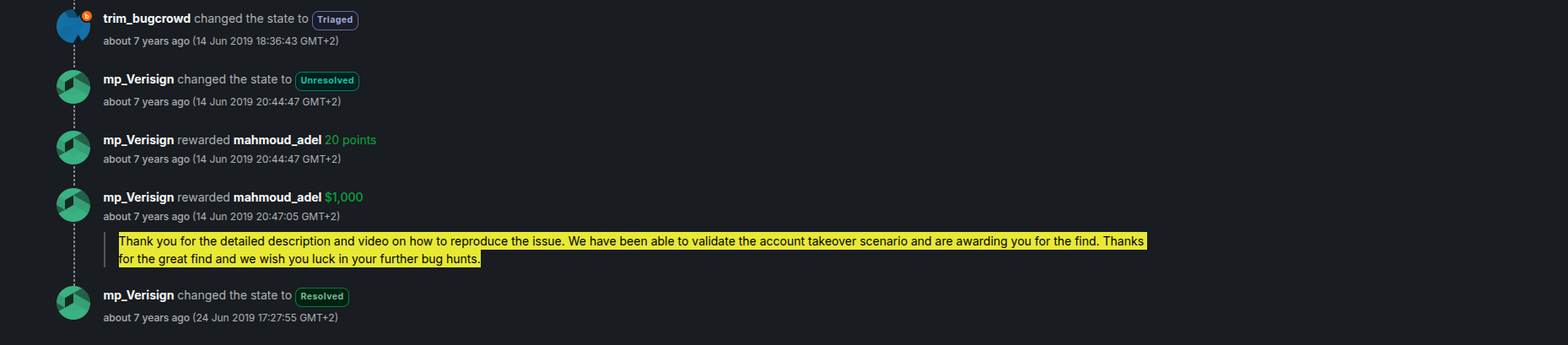
No fix date is asserted here beyond what was publicly acknowledged. The report was triaged and rewarded; patch verification, if any, would have been handled through the program.
Mitigation — Validate OAuth state Parameter
Recommended mitigations documented at the time, aligned with OAuth 2.0 best practices (RFC 6749, Section 10.12 — Cross-Site Request Forgery):
Require and verify
stateon every OAuth callback:- Generate a cryptographically secure random value (at least 128 bits, e.g.,
crypto.randomBytes(32)). - Bind it to the user’s session server-side before redirecting to the provider.
- Verify exact match on
GET /connect/googlecallback. Reject the request ifstateis missing, mismatched, or reused.
- Generate a cryptographically secure random value (at least 128 bits, e.g.,
Enforce single-use and expiry:
- Invalidate
stateafter first use. - Set short expiration (e.g., 10 minutes) to limit replay window.
- Invalidate
Add defense in depth:
- Set
SameSite=LaxorStricton session cookies (JSESSIONIDand auth cookies) where compatible. - Require re-authentication or additional CSRF token for account linking actions, not just login.
- Validate
Referer/Originas a secondary check, not primary.
- Set
Do not rely on
codesecrecy alone:- The authorization code is not a CSRF defense; it authenticates the Google identity, not the user who initiated the link.
Example server-side check (pseudocode):
// On initiating link:
const state = crypto.randomBytes(32).toString('hex');
req.session.oauthState = { value: state, expiresAt: Date.now() + 10*60*1000 };
res.redirect(`https://accounts.google.com/o/oauth2/auth?...&state=${state}`);

// On callback /connect/google:
if (!req.query.state || req.query.state !== req.session.oauthState?.value) {
  return res.status(403).send('Invalid OAuth state — possible CSRF');
}
if (Date.now() > req.session.oauthState.expiresAt) {
  return res.status(403).send('OAuth state expired');
}
delete req.session.oauthState; // single-use
// then exchange code and link account
For penetration testing of similar flows, always test linking, unlinking, and re-linking, not only primary OAuth login. Intercept the callback, remove or replace state, and assess whether the action still succeeds under the victim’s session.
Lessons / Takeaways
- OAuth CSRF is most often missed in linking flows. Login CSRF gets attention; account linking CSRF — where an external identity is attached to an already-authenticated session — is frequently unprotected. Test every state-changing OAuth callback, including
connect,link, andunlinkendpoints. - Manual interception still outperforms DAST for logic flaws. Automated scanners validated the presence of OAuth but did not flag the missing
statebinding. Proxy interception and manual removal ofstateimmediately confirmed the bypass. Document the raw callback, then replay withoutstateunder a second session. - The
stateparameter is a session-bound CSRF token. Treat it as such: random, unpredictable, bound to the initiating session, verified exactly, and single-use.SameSitecookies help but do not replacestatevalidation. - State-changing GETs amplify CSRF. The callback used
GET. Any GET that changes account linkage should either be POST with a CSRF token or be protected by the OAuthstatecheck. Prefer POST for linking completion where possible. - Minimize SEO noise, maximize signal. This finding used precise keywords — CSRF, OAuth, State Parameter, Google OAuth, Verisign, DomainScope, Account Takeover, Bug Bounty, Responsible Disclosure — in the report, description, and headings. Clear reproduction steps with redacted artifacts accelerate triage.
- Report only what was validated. No CVSS was assigned by the program at the time; no patch timeline is claimed beyond triage and reward. Keeping the timeline to what was documented (reported April 2018, $1,000, HoF) preserves accuracy for future review.
Disclaimer — Responsible Disclosure
Testing was performed solely on accounts owned and controlled by the researcher, within the scope of Verisign’s authorized Bugcrowd bug bounty program. No customer data, production accounts, or unrelated user sessions were accessed, modified, or tested. All reproduction used the researcher’s own LinkedIn and Google test identities.
This write-up was published after triage and reward via responsible disclosure, with sensitive values redacted to [REDACTED]. Hostnames and flow details are preserved for reproducibility and defensive learning. No active exploit is provided; the PoC is reduced to a sanitized GET and a static HTML pattern.
For questions about the finding or mitigation guidance, contact via the Bugcrowd profile at https://bugcrowd.com/h/mahmoud_adel or the site contact page.